Monday, 13 April 2020

Ten Cs for teachers to stay well while staying at home for work :) Part 3


And to finish this blog series of 10 Cs to stay well while staying at home for work. The focus this time is on our mindset. 

Challenge:

At the moment we have been presented with an opportunity for us to learn new things and to do things differently, we may not have chosen the circumstances but we can choose to embrace the opportunity to stretch our brains. Our brain does love to be challenged- this will come from taking risks and making mistakes while we learn, just like we ask our learners to do in our classrooms every day!

We might have the challenge of creating a work space in our homes, as a wee tip I am fond of using my ironing board at times as a substitute desk 😊 (it doesn’t get used for much else very often to be honest!) We might have the challenge of how we work with our own children needing us as well, I’ve been getting my boy to join in on the challenges I set my class and occasionally film him doing things to share with the class, he also sometimes joins in on my songs or listens to me read the novel I am for my class. We have the challenge of what to do for our classes, how much work to set and how to meet all the diverse needs in varying circumstances. My suggestion is to start off by keeping it simple and going slow, we are all new to this.


Contribute: 

We all offer value and I encourage you to share your gems with others, and there are so many ways you can! You don’t have to learn all the new things, share the load by sharing the wisdom with your colleagues. Even when we work from home we have the capacity to collaborate, there are tools we can use to help us do this more easily and we might even come up with ways to work together effectively that we can use after all this is over!

Also consider the unique skills and talents that you have and how you can use these to connect and engage with your learners- you might record yourself singing favourite songs to share with your class, you might write poems or stories for your class about things that you know will appeal to them, you might create art or do cartoons, you might be great at sewing or crafts and you can share examples of what you are making… the only limit is your imagination.

Change:

Let’s be honest teaching shifts and changes all the time so teachers are not strangers to change! Change by its very nature can cause uncertainty and be distressing. It can also lead to excitement, energy, and growth.
We are in a privileged position to support our learners to navigate this very different learning environment by being champions of change. We can show them how to embrace change, how to be calm and connected when faced with uncertainty.

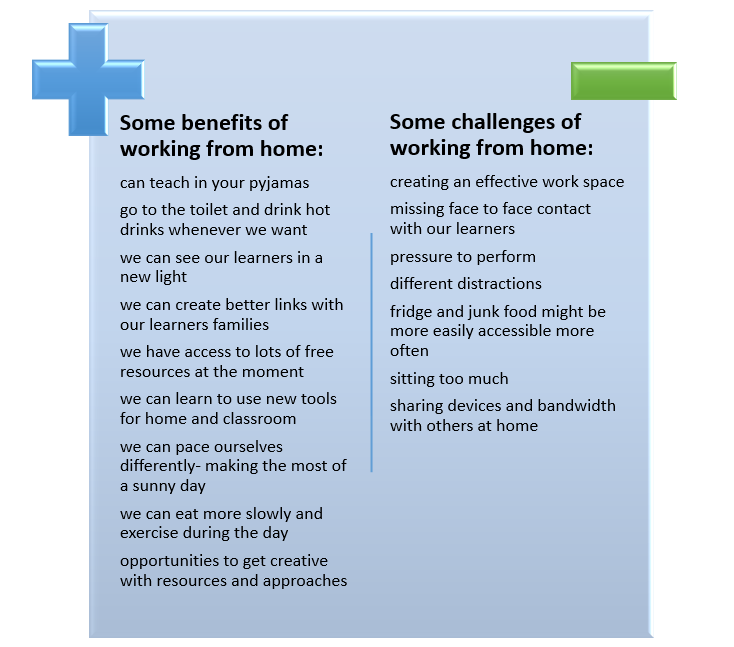
Working from home is a change for many of us, it has a range of benefits as well as challenges, as with any changing circumstance.  What are you going to focus on?  


Choice: 

In every moment we have the power to choose, I know it is a bit of a cliché but I’ll say it here again because it is a useful mindset to adopt, we cannot choose our circumstances but we can choose our attitudes.

We can choose to see all the problems we are faced with in the coming weeks; we might be feeling overwhelmed or stressed, which are perfectly normal emotions especially now, but if we feed this negative energy then all that we do will be coloured by this negativity, instead of rose tinted glasses we'll be wearing grey, gloomy lenses instead. We can choose to see the opportunities that come from setbacks; the opportunities to create something new, the opportunities to learn new things, the opportunities to give positive energy at a time when many people may be struggling, the opportunity to continue doing our important work.

A shift in perspective doesn’t mean denying our feelings, it means giving ourselves time to feel our feelings and then making choice about how long we are going to give any particular feeling the floor. If watching news or social media feeds fuels our anxiety then choose to switch off. If you are feeling uncertain (and who isn’t at the moment) choose to focus on what you can control, even just one little thing. 


Working from home can be seen as a burden or a privilege. We haven't chosen it but we can choose to make the best of the circumstances. 

1. Focus on creating a healthy internal environment for your work- create calm, act with caution around negative habits, and make sure you make time to chill out. 
2. Focus on your work- remember your can-do-ness (you've got this!), let yourself get creative and connect with others regularly. 
3. Focus on your mindset- face challenges with a sense of optimism, contribute and collaborate, be a champion of change and always remember the power of your choice. 

Take care out there everyone. 

Wednesday, 8 April 2020

Ten C’s for Teachers to stay well while staying at home for work 😊 Part 2


Continuing with our 10 C’s... 


Can-do-ness

This is about self-belief and self-efficacy; you are a competent teacher and this situation doesn’t change that. Teaching is likely going to be quite different, and there will certainly be challenges, but the heart of what you do hasn’t changed… you are still building and maintaining relationships.

Remember, you’ve got this!  

It helps to spend some time thinking about what your strengths are and how you can use those strengths in different ways. For the areas that you are uncomfortable with, this is a time to ask for help, there are a number of people out there ready and willing to help us.


Create


There is a myth out there that only some people are ‘creative’, and the rest of us just aren’t. Creativity isn’t just about being able to make masterpieces, it is something that is an innately human endeavour. We are creative when we play with ideas, when we whip up a meal, when we put together an outfit, when we plant a garden, when we make art, when we tell stories, when we plan a lesson… you get the idea. Even a small amount of creativity where we take risks and embrace our mistakes can be great for our brain and sense of self.

We have been given an opportunity to have time to really get creative in our work and play which could be a little bit exciting. It doesn’t have to be straight away, you might not be ready yet, but the opportunity is there. Perhaps start small and work your way up.  


Connect

This is huge. Connection with others is a physiological need; we can’t survive, let alone thrive, without other people from the time we are born. Consider how you are connecting with colleagues, students, your friends and family. As many are saying at the moment we may be physically isolated but we don’t have to be socially isolated.

Relationships are key for us in teaching, always have been, always will be.  How we relate to our learners is important- our communication channels might be different now but the need to form and maintain connection remains the same. One of the differences is that our communications may be more open, with more engagement with the family of our students and more personal as we are visiting each other’s homes (albeit virtually). This could be hugely positive in creating stronger links between families, learners and their teachers. 


This is a big question for us to consider and keep in mind as we plan ahead. What do we really want for the learners in our care? 


Monday, 6 April 2020

Ten C’s for Teachers to stay well while staying at home for work: Part 1

A while back I was what they called a tele-worker- I worked from home for part of the time and travelled for the rest. It was a great lifestyle and I really enjoyed working from home. Fast forward a few years and I have studied and learned a bit about teacher wellbeing as well as returning to full time classroom teaching. 
Now we are faced with a time of uncertainty where many of us will be working from home for a portion of time, how long we aren't really sure yet. I know that for some of us this will be new and that can be unsettling. So I have gathered some thoughts from my learning over the years here, I hope it is helpful.


Calm:

Calm really is a superpower especially when working from home. There will be frustrations at times and the capacity for overwhelm is huge too. I am noticing at the moment there is so much information and so many companies sharing their products and services that it’s easy to become overwhelmed by it all.

Take a breath and, if you can, focus on one thing at a time. Ask yourself “what is the most important thing for me to do right now?”. The answer may simply to focus on your breathing for a while and that’s OK… big, juicy, deep breaths are great for your body and mind.


Caution:

Here are three red lights I found for when you are in the work zone at home:
  • ·       Sitting too much- it is easy, especially when using devices for communication, to sit for too long which isn’t great for us in the long term. One way to make sure you don’t sit too long is to set an alarm to get up and move every 20-30 minutes.
  • ·       Bored eating- when you have a kitchen near your workspace, and I know some of us might even be working in our kitchens, it is easy to reach for a chocolate biscuit because we are bored. There’s nothing wrong with the odd chocolate biscuit but high energy/low nutrient foods are not an ideal regular food. Try to have a little snack bowl of fruit and nuts readily available and remember to drink water regularly.
  • ·       Distractions can be everywhere… especially if you are looking for them!- The flexibility of working from home is fantastic, you can make more choices about when and where you do the work, I love that. But it is easy to be distracted by TV, other people, housework, other projects and so much more. Remember that the brain cannot focus on two things at the same time, so if we are multitasking we are actually rapidly switching focus which can be taxing on our energy. You can get through more, faster if you focus on one thing at a time.

Chill out:

One of the other pitfalls from working from home is that you can be working all the time, it can be hard to switch off but switching off is really important. It might be that you only do work in one particular spot in your house so that when you are away from there you are not working. Or you could log out of work apps or switch off devices at a certain time. Or maybe you schedule your day so there is specific work time and specific down time. Whatever works for you, but please make sure you switch off, it’ll make you more productive and a happier human being 😊

Also, as educators we are in a giving profession and for many of us giving is easy. In order to be able to keep giving however we need to carve out a little time for ourselves. It might be that we create a calm soothing space to chill out. It might be that we do some reading, a hobby, something physical, meditation… you get the picture. This is not selfish, this is refuelling so you can keep doing what you do best!


I'll follow up with some more around our work life at home. 

Tuesday, 9 October 2018

Genius Hour- giftEDnz challenge

Kia ora koutou... 

The challenge we have is to explore Genius Hour. I have often found it enticing, dabbled a little, but I couldn't quite see myself following the rules correctly. Tonight I read the following blog post: Idea Starters for the Genius Hour Classroom  and what sweet relief! In the comments there was a thread about research and one comment struck a chord: "it’s a grassroots movement without a lot of rules about “how to do it.”" 

Now regardless of whether this is correct or not it has give me a sense of freedom... no more feeling like I need to have a bunch of lists and criteria etc. I can have the focus on pursuing a passion and that's OK. A focus on creation as opposed to consumption works for me too. 

I feel that this will meet a need that I haven't addressed fully for some of my tamariki this year fully. I am hopeful. 

The lists of possible areas that may be explored are appealing too: 
  • human ingenuity
  • health and social education
  • environment
  • community service
  • The Arts
  • design/make/build something
  • learn new info
  • investigate passion
My intention is to start a conversation around this with my terrific tamariki and build it together. It will just be a start for us this term. 

Monday, 8 October 2018

Finding your Tribe... a giftEDnz blog challenge post

Today is Day 7 of the giftEDnz October blogging challenge and the theme for today is finding your tribe. The inspiration was this beautiful post https://spark.adobe.com/page/ABPCjywrC2gRO/.

For me, finding your tribe is all about belonging and as a teacher it is my job (and privilege) to create an environment that engenders this. So I thought I would share some of the ways we work in Room 5 to build a learning community that embraces belonging.

A couple of years ago I was at a Teachers Matter conference (please check here for information about the Jan 2019 conference) and I heard Adrian Rennie speaking about his classroom practice, I got a lot from his work including the use of a class chant. I created the chant below a couple of years ago for the class and it is handed down from one class to the next now... it is part of a Room 5 tradition. This poem/chant covers our expectations, or qualities of Room 5 learners (including myself), rather than use rules.


We spend time unpacking what each of the expectations/qualities look like/sound like/feel like in action as a class when we start the new year. Each of us also add a feather to our class kakahu (cloak)- this is growing each year, so we are part of something bigger than just ourselves and our class this year, it is becoming a rather beautiful keepsake. 

This year we created inspiration boards that shared a little about our aspirations and loves. These were reduced on the copier and made into a framed entrance so people would know a little about us as they entered our classroom. The children took the originals home so they could remember these things at home too. This has been a much loved area of our classroom and attracts interest from all visitors. As part of this wall are QR codes with us sharing our pepeha- another way for us to get to know each other. 

We spend a lot of time exploring our brain, at the start of the year- how we learn, think, cope with big emotions. We have a calm down zone in our classroom. We have responsibility buddies (who change regularly) to help us with our learning tasks in the classroom. We explore strategies that help us to become better learners including what we can do to support the learning of others by finding out their learning preferences, and understanding a bit of how the brain works. This work is ongoing and becomes part of our learning language in the classroom. 


In the classroom I prefer to use inclusive language... we/us instead of I/me, our not mine or yours. This is deliberate. It helps to increase a sense of ownership and belonging. But this is only the tip of the iceberg... language is so powerful! 

This year I was lucky to have the opportunity to spend a day learning from Teacher Tom (http://teachertomsblog.blogspot.com/) who spoke at length about democratic processes in the classroom. I have always thought I was doing OK with that but I realised I have a long way to go to truly deliver my vision of a democratic classroom.  He recommended exploring the work of Tom Drummond (https://tomdrummond.com/leading-and-caring-for-children/) and it is brilliant. There is so much to learn. The use of democratic processes truly engages students as citizens in a learning community... we all have a contribution to make and an expectation to work in ways that enhance our community of learning. This takes time, commitment and effort but it is well worth it I believe. 

There is a lot of choice in our classroom, that comes with its challenges of course but we are getting there. With the range of choice available there is scope for tamariki to work with a variety of others, including others from different classrooms at times. The combinations that I see pairing or grouping up sometimes surprises me which is a good thing, without being contrived these groups either succeed or fail on their own merits and the learning that comes from this I think is important for developing life skills. They also provide real opportunities for us to explore problems (and solutions) that happen when working and living and dealing with people... when being part of a group or tribe. 

At the end of each term we conduct a class audit, exploring what has worked and what hasn't, along with what we could improve or change to make our class even better. In the last term we used a PMI framework (plus, minus, interesting), the dialogue that went on as we explored this over a couple of days was great, and it was neat to see the extent of engagement and improvement in deep thinking about the topic from earlier in the year. We are stretching and growing and it is a privilege to be part of the learning community we are developing. 
This is Einstein the elephant... our class mascot, and one of the greatest learners in the world!
Thanks for Adrian Rennie for this idea too! 


Our classroom is full of quirky folk (me included), learning to embrace what makes us unique- our differences- our own brand of weirdness, and respect and enjoy the uniqueness of others is part of what we aim to achieve in our learning community. Again, we have some way to go but it is, as always, a mission worthy of pursuing. 


Saturday, 6 October 2018

Do you think you are better than everyone else- a reflection

A couple of years ago I wrote a post entitled 'Do you think you are better than everyone else' where I recounted a story from my childhood that does haunt me even now (over 30 years later)... it was a tiny moment really but the words cut deep and created a loop that pops up from time to time. At the moment I am participating (a little!) in a blog challenge with giftEDnz and I am also in the midst of school holidays so a LOT of personal reflection is going on. I have also started reading Brene Brown's book 'Rising Strong' as resilience is a topic I am interested in and I love her work, it has got me thinking about vulnerability again and facing my own demons. I am not gifted but I think that the moment I had as a child could be one some of our gifted and talented tamariki experience, the words (and the venom they are delivered with) might be different but the damage done could be similar.

This is the moment (click on the link above for more): 
'I was one of those kids that loved learning, heck I still do, and I was always looking to stretch myself, again I still do. One day when I must've been about 11 years old, I had completed some work earlier than my classmates, I had checked it and then waited in line to ask my teacher if I could please have some more work. The response from my teacher was less than supportive, in fact the response was a loud (enough to silence the rest of my classmates) "so you think you are better than everyone else?" I was horrified. That was not what I meant at all, I just wanted some more work to keep myself busy and tried to explain that in a quiet voice but to no avail. I didn't get any more work, all I got was humiliated and shamed. '


I never thought of myself as a particularly precocious child, but maybe I was, who knows? What I do know is that this experience made me nervous to stand up, to speak up, to be vulnerable. I vividly remember sitting at my desk having completed my work and looking around the classroom seeing everyone else still working away (or goofing off because we were a class of real human beings with different needs, skills and interests... however they were doing so in an unobtrusive manner to avoid being caught), I weighed up the option of staying there quietly and doing nothing but it was going to be a long time which would be really boring and I thought perhaps my teacher would be proud of me showing an interest and desire to do more (people pleasing is something I mastered early on... a work in progress too) so I took a deep breath and walked to his desk. I'll never forget the look of disdain as he spoke to me... or perhaps disdain is what I perceived rather than what was really there, never-the-less the look, the words, the silence... it stung. 

Fast forward now to last week, and I am presenting a workshop at a conference. As always there was the flutter... what right do I have being here talking to people about stuff? What makes me think I am good enough to do this? Now, I have a process to tamper that down and walk into the vulnerability, face the fear and do it anyway kind of approach. The workshop went well, I think, and at the end one of the teachers there asked if she could come and observe in my classroom... instant anxiety flare... and I fumbled my way through saying yes of course but please know it is a work in progress and I am on  a journey and certainly haven't got it all sorted etc etc etc. I created the excuses immediately because perhaps one of my biggest fears is being exposed as the fraud I am sure I am. After all, what actually makes me think that I have anything to offer? Cue the refrain: What makes me think I am better than anyone else? 

Now I know that this is mind talk and that I have the skills to manage that but the seeds planted in our early years can grow strong roots. In those times when our vulnerability is exposed that is perhaps when those seeds that have grown over the years blossom in their healing or hurting way depending on what seeds are planted and then nurtured. 

And so, my challenge for myself is to be present and aware of the seeds I am planting and those I am nurturing in the minds and hearts of the young people I am privileged to work with. To prune what I can of the harmful ones and provide light, warmth and nutrients to the ones that will help my tamariki flourish in all the ways they can. 

Monday, 1 October 2018

Every child deserves a champion

I have been particularly lax with my blogging this year (and possibly last year too) so I have decided to take on the giftEDnz October blogging challenge to get me back on track and consolidating some thoughts... who knows there could be some gems that arise in it all as well! 

Today's topic: The late Rita Pierson said that “Every child needs a champion.”  How can
   we be champions for our gifted and talented students in particular?

For me a champion is the person that is prepared to stand tall for others when they haven't the resources at the time to do it for themselves.

If we are to be a champion for our tamariki, particularly our gifted and talented tamariki, then we have to be prepared to stand tall for them especially when they are marginalised or lack the resources to do it for themselves.

In order to do this we need to know our tamariki- know what switches them on and off, know their social and support networks, we need to observe (with our hearts and our minds) to read what is happening for them and how they engage with the world around them (at least in our settings), we need to listen to them (really listen!)... and we need to ensure we identify those things about them that we like, dare I say, love. I always remember the quote that says that some of the children that need love the most will ask for it in the most unlovable ways... we need to keep in mind that all behaviour is communication and so listen to the cues and try to see the human being behind the behaviour if what is presented to us is challenging.

We also need to get real and get informed. Get real about the challenges you are presented with, what you don't know so then you can find out. Read, ask questions, attend courses, talk to as many people as you can to get the information, and resources, you need to better meet the needs of the tamariki in your care.

And then we can be the champions these tamariki deserve.

We can get alongside whanau and support them.
We can argue for funding and resources.
We can create spaces and opportunities for their voices to be heard.
We can lobby different decision makers to consider our gifted and talented students in their decisions.

Every child deserves a champion. We are those champions.