Sunday, 23 November 2014

Teaching is leading


From my perspective if you are a teacher (and let's think broadly about that term as well) then you are a leader and that is a tremendous privilege and responsibility.

Recently I attended a presentation about successful educational leadership with associate professor Ross Notman from the Otago university. He presented findings from his own research as well as international research including the International Successful School Principalship Project. As we went through there were opportunities to reflect on our own leadership practices and experiences of leadership, in this time I often came back to the thought that these qualities are not the exclusive domain of successful school principals.

Below are three of the areas discussed and how these might look for classroom practitioners:

Building a strong vision and setting expectations
Here we are talking about motivating others, setting high expectations, having a clear sense of purpose 
In the classroom how do you share your expectations? How do you motivate your learners? Are you clear about why you are doing what you are doing? And how do you communicate this with your class?
When we set clear expectations our students have confidence to complete set tasks. When they know why we are doing what we are doing there is a better buy in and if well thought out with them in mind then the learning will have greater relevance and therefore be more meaningful. Motivated students are more likely to be self managing and committed to the task at hand, whilst we don't want to create a dependence on us for motivation it is important that we support the students to get on board and stay on board. We can use WALTS (We Are Learning To Statements) to help clarify the our expectations, we can use rubrics and tools like SOLO taxonomy among others.
When talking about expectations we are not only talking about teaching and learning, there are behavioural expectations as well. One important thing to consider about expectations and is that unless these are held/owned by the whole group then they are unlikely to be motivating or sustainable.

Understanding and Developing People 
Thinking about building relationships and developing dispositions, valuing others, practicing what you preach
The three R's of teaching is sometimes described as relationships, relationships, relationships. I agree! The fabulous Allie Mooney shared the following quote at a conference I attended many years ago "you need to reach me before you can teach me", I have never forgotten it.
How do you build relationships with your students? It is not about being friends but getting to know each other. How do you develop dispositions in others? What about valuing all the students in your classroom? Do you practice what you preach?
If we know what switches people on and turns people off we are better able to help them stay motivated and share a vision that is palatable. When you are teaching is your focus on the subject/topic or the different learners you have in your class? Where your focus is will make a huge difference to the quality of the relationships you have with your students. It is not always easy to like all the children/young people who enter our classrooms, some come with some pretty tough baggage, it does help though if we approach all students with a desire to identify their strengths and unique gifts as everyone has something of value to offer. A question I have gained from a parenting expert Dr Monika Potter is to ask yourself 'what would love do?', it is a helpful reminder when dealing with difficult behaviour.
If we want our students to walk along a path with us, to respect and respond, then we need to be authentic... they can smell the disingenuous a mile off and if we don't practice what we preach then that will erode trust which is one of the foundations of relationships. It is OK to be human and make mistakes, admit it, apologise and move on if you do... in just the way you would expect your students to make amends if they made a mistake.

Redesigning/Refreshing the Organisation 
This is where we are establishing collaborative cultures, restructuring to meet changing needs and managing conflict. 
How do you create opportunities for collaboration in your classroom? What about distributed leadership... do you share ownership? How do you identify the needs of the learners in your care? What do you do about changing needs? How flexible is your classroom programme? How do you manage conflict? Do you create opportunities for honest, healthy discourse in the classroom?
We can be the masters of all destiny in our classrooms but when we do that we disempower our learners. Think about ways that we can share decision making with our students. I remember with one class giving them some guidelines for choosing desk groups then let them go for it, I was impressed with the quick way they selected their groups and how successful they were. Collaborative cultures take time to build and it is important to work on creating an environment where it is safe for students to disagree or have different opinions even with the teacher. When groups go too far with their desire to reach consensus we start to lose divergent, innovative thinking as the need to fit in with the group supersedes anything else. This is called 'group think' which I would imagine as teachers we would want to avoid developing in the minds of our young people if they are to be the leaders of the future.
Teachers have a lot of competing demands on our thinking when planning for our students so consider how much of what you do in the classroom is driven by student needs. When you are thinking about needs are you only concerned with the academic or do you look at the whole person? I suggest that if you are not considering the social, emotional, physical aspects of your students lives you might be missing out on some important information which will enable you to better tailor your programme to meet diverse needs and help your students do their best. If a child is struggling with their learning sometimes the root of the problem may not be the subject area or lack of ability but could be a health issue, problems with friends, or any number of things going on. Focusing only on the academic may lead to little improvement or, worse still, increase anxiety and create more problems. This brings us back to knowing our students and relationships, relationships, relationships.

There are many other qualities we could discuss including being leaders of learning, modelling an inquisitive mind, thinking dispositions and so on but I think this is a helpful start to establish the understanding that teachers are leaders. These qualities can equally be applied to parenting and other contexts I am sure.

Leadership for me is a learning journey. I see so many opportunities in everyday life to apply aspects from my learning in leadership so far. If you are interested in exploring leadership a little more I suggest that Simon Sinek's leadership material is a good place to start.

Simon Sinek shares valuable insights around leadership and is well worth following. 


Thursday, 13 November 2014

Getting Going with Growing 4

Gardening is a pursuit that teaches important life lessons... this week resilience, patience and wonder.

After the attack of the killer sheep and the subsequent repairs to the fencing as well as putting up some wind proofing for my latest attempt at growing corn I thought we had catered for just about everything.... but not quite!

Public enemy no 2 has been identified and no it is still not the white butterfly.

This time it was unseasonal weather! Check out the little video clip below to see what hit, literally, our garden earlier this week.

The size of the hailstones were quite spectacular too.

The spinach that survived the attack of the killer sheep did not fare quite as well against the hail stone
bullets that pelted down from above.
Worse still was the unexpected frost from the hailstones overnight as they did not melt away... the potatoes (largely self seeded) did not fare well as the blackened curled leaves here show. I am hoping that they might come away again though... fingers crossed.

The pumpkin plants however do not look like they will come away again. It was so disappointing as this is my second attempt with my pumpkin seedlings and they were looking so good, now they are yellowed, curling up and very sad.

BUT this is gardening, and there's no point moping around about it. This is where resilience comes in, I could chuck it in claiming it is too hard with the pumpkins, the spinach and the brassicas but I have a glasshouse full of growing plants (and I am lucky I still have five pumpkin seedlings in the glasshouse to transplant).
There are seeds coming away that we planted a couple of weeks ago and I thought were not going to strike... they are now popping up all over the place!
The other day I was looking at the bed where I had planted sunflower and sweet pea seeds two weeks ago and there was nothing happening, I had decided I would put nasturtiums in there instead when I got the time... well today I walked past and had a look to water a couple of seedlings I had planted earlier and lo and behold there are a whole heap of little seedlings now coming through, what a difference three days make! A little bit of patience pays off, and if they had been right up when the hail hit, who knows, they might not have fared so well.
Sunflower seedling... exciting! 
On reflection there are lots of life lessons I am getting from gardening, here are a couple from this week:

  • very few things in life are ALL bad, focus on what is going right if you can
  • don't put all your plants in the one spot, diversification is key
  • if at first you don't succeed, look at what you could do differently and have another go 
  • it is OK to try something and fail... that is a great place for learning to happen 
  • patience is a virtue and nature knows it well

In gardening, as in life, you win some and you lose some. If you are prepared to focus on the wins, work through the losses and approach as much as you can with a sense of wonder then all going well things will bear fruit. 

Monday, 10 November 2014

Getting Going with Growing 3


Well we are another few weeks on from my last gardening blog post and we have actually eaten something from the garden so that deserves a mention among other things.


So here is our first scrumptious offering from our garden, a Great Lakes lettuce, which we have enjoyed for several meals so far. Crunchy leaves for fabulous salads and juicy sandwiches... all the tastier because it has come from our own garden!

One of the great things I am discovering about gardening is that it is an opportunity for ongoing learning through trial and error. I am loving the opportunity to be a bit of a scientist with the garden and trying some new things out.

  • We have grown seeds in individual pods using empty toilet rolls. We have filled them with dirt (seed raising mix) and have placed one or two capsicum seeds in them. To be honest I was beginning to despair that nothing was going to happen but in the last day or so some shoots are coming up. We have planted both seeds from a packet and some I harvested from a capsicum we had eaten so it will be interesting to see what grows, 
  • We are now using our 'ucky bucket' seaweed water to feed new and transplanted plants. We water this down so it looks
    like weak tea and use this when we are planting... at the moment most plants have responded. 
  • We have had a go at planting onions from onions that have sprouted in the cupboard. I found this blog post and thought I would give it a go. So far they seem to be growing, well they haven't withered and died so that's a good start! (http://www.anktangle.com/2011/03/growing-sprouted-onions.html) 
  • We have planted our second lot of pumpkin seedlings, this time in a new plot with some slightly different soil so here's hoping this time they don't die! 
  • I am still to master the mixed plantings with flowering plants, I have had some success with nasturtiums but my marigolds are pathetic. We will work it out eventually. 

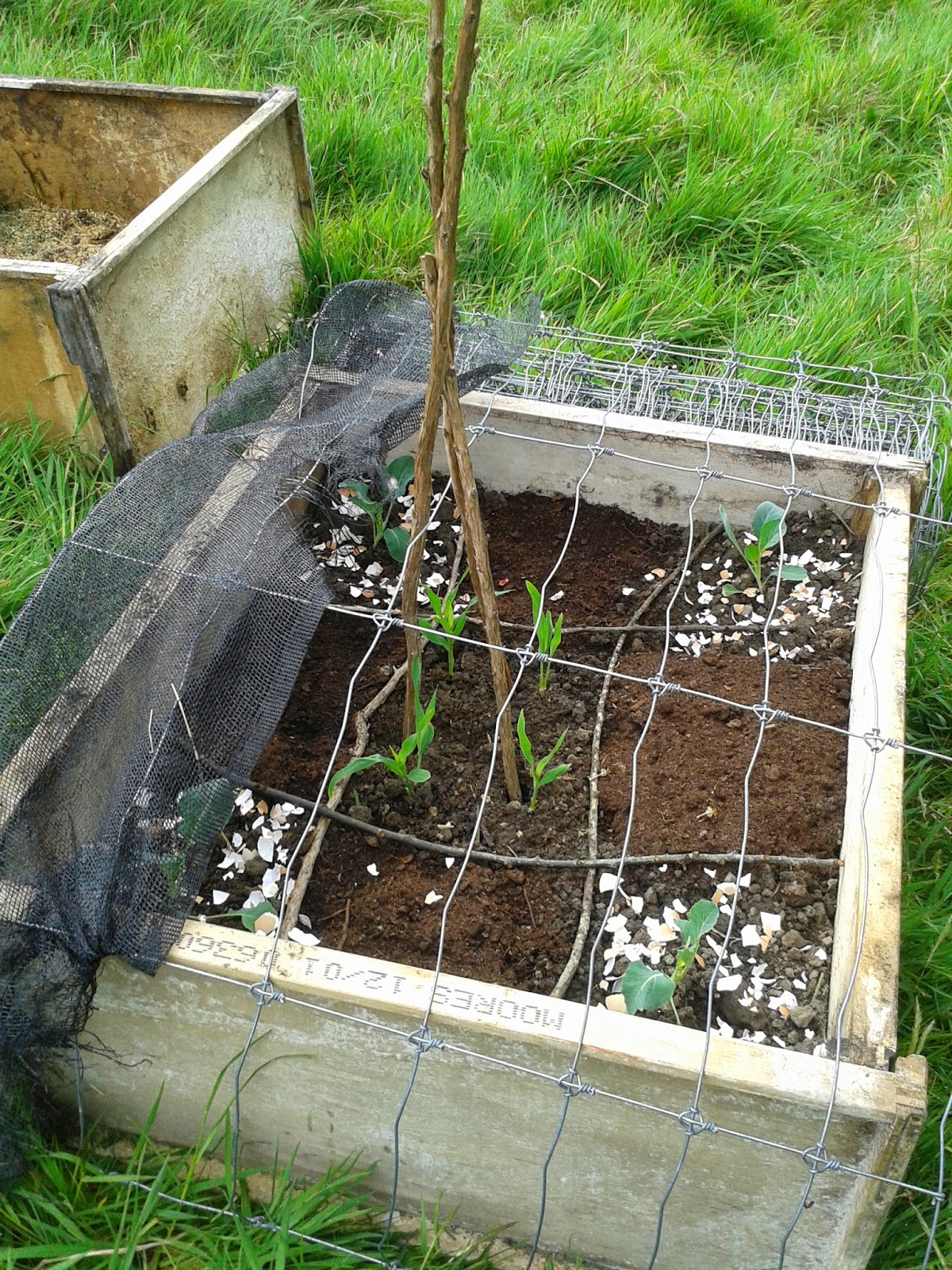
  • We have also had a little go at a slightly different planting arrangement inspired by the 1 metre squared garden concept. It gives a little bit of a patchwork effect and so it looks good at the moment. I have sown carrot seeds on the side plots, brassicas in the corners and corn in the middle. We are trying the corn again, but this time in different soil and with a little more protection from the wind we hope. (http://www.tuigarden.co.nz/howtoguide/square-metre-gardening-guide) 
  • I continue with the broken eggshell slug protection system and whilst I think that is working I have discovered an even more vicious enemy of our humble brassicas... read on... 
This week public enemy number one of the garden became... SHEEP! 


Oh they look very innocent back in their paddock now but the results of their ruminating in my garden was quite obvious. Clearly they don't love spinach but have a thing for cabbage, broccoli and cauliflower! 
One of the cabbages that were savaged but still in the ground. 
The spinach that lived to tell the tale
We have put in some measures to deter the sheep from doing any more damage with some additional fencing at the bottom of the garden and hope that proves as effective as the cat proof netting over the garden plots has. 

So for now I have forgiven the sheep, as long as they stay on their side of the fence!

It is getting exciting as some of the plants are beginning to fruit so I will leave you with some images of new fruit coming... the anticipation of a fruitful summer is a wonderful thing. Happy growing folks. 
Zucchinis....

Strawberries....
 
Little grapes!


Saturday, 1 November 2014

Same bat time, same bat channel- can TV help us improve student engagement?

Here's a little thought I have been having for a while... what if we looked at what TV stations do well to capture and maintain an audience and applied that learning in our classrooms?

I know it sounds a bit odd and in our day where we have varied forms of visual/digital entertainment perhaps the analogy is redundant but I'll let you decide that.

This is some of what I have been considering:

  • On TV channels they have specific programmes airing at certain times but it shifts and changes depending on the day. There are some regular programmes and some variation, there are also thematic times such as Christmas or special days of remembrance where the schedule reflects that theme. 
  • There are regular ad breaks, often every 10-15 minutes, which can be entertaining in themselves or provide us with an opportunity to shift focus or move around a little. 
  • There are a range of programmes scheduled which are designed to meet the interests of varied parts of the target demographic. 
  • The target demographic is carefully considered and monitored. 
  • Programmers use cliffhangers and other strategies to hook their viewers in and make them want to tune in next time (as the old Batman series said 'same bat time, same bat channel') 
  • Sometimes programmes that are less popular are sandwiched between two more popular programmes to keep their viewers tuning in. 
  • What is coming up may be talked about in the credits from the previous programme to ensure that viewers do not switch channels. 
When we apply this to the classroom here is what it might look like:
  • Lots of consultation with the students so you understand your 'demographic'. What are their favourite subjects, least favourite, how do they prefer to learn, what are their goals, strengths and needs... then consider how you can cater for that (hint: they won't be the same as the class you had last year, or the year before and they will probably change preferences throughout the year too)
  • Short snappy lessons- don't drag on boring your audience or they will tune out! 
  • Previews of what is coming up as we round off what we have just done e.g. (after a summation of what was learned) "so that was maths folks, coming up we will be exploring the fascinating world of adjectives in our writing...".  
  • You can also preview a new topic coming up next week or next term at different times to build anticipation and buy in.  
  • There will be predictability with daily scheduling but there will be variability between lessons and you may adjust your schedule seasonally. If we do things the same way all day engagement will drop off (hint: being talked at for long periods of time in the classroom is exhausting and encourages tuning out). 
  • If something is a less popular subject then schedule it between two other more popular subjects or parts of the classroom programme e.g. if there is a general reluctance with math and written language don't schedule them immediately one after the other.  
  • Stop regularly to allow people to move, shift focus, stretch, ask questions or talk. (Click here for some reasons to consider more action in your classroom) 
  • If something isn't working then consider changing it, do something new or different, find another way. You could trial different things to see if they work, like pilot programmes.  

We want our students to tune in, buy in and engage just like a TV station wants their viewers to do, the big difference of course is that we don't want our students to be passive 'viewers' of the learning but active participants whose opinions, interests and needs do matter. And to finish here's a really bold thought, what would it look like if every student had their own schedule designed with them in mind? Just an idea...  

So, how do you get your students to tune in to the learning offered in your school or your classroom? 

By the way, please excuse the spelling for some folk out there, I come from New Zealand :)


Monday, 27 October 2014

Getting going with growing Part 2

Last time I wrote about our garden we had just started getting established.

A month later and the garden is growing in many ways, as are the gardeners! We have had our ups and downs of course but there is enough success to keep me going ;) I am learning to be more in tune with nature, more observant and responsive. I am learning through doing, trial and error, which is really quite motivating, although the thought of eating our own lettuce sandwiches real soon is quite motivating in itself of course!

I am also finding the time in the garden really quite rejuvenating. It is like a quiet break for my brain and even weeding is not a real chore. My little man was quite unwell for a week or two so time in the garden was limited and I did find that I actually missed it... we haven't had the garden for that long but it is already becoming a habit.


Here's the round up:

The highs:

  • the lettuces are growing beautifully and hearting up, I am just about to put another lot of lettuce seedlings so we can keep it going
  • the tomato plants are also doing really well, I have staked them up and they now have flowers on them too 
  • the strawberry plants in the glasshouse are much bigger than those outside but both have flowers and are doing fine
  • we have planted some pepper, cabbage, cauliflower and spinach plants, all of which are doing well 
  • the garlic in the glasshouse is going well and the onions outside are now looking stable 
  • the wire over the outside beds is working well at keeping the cat from sunbathing in the garden beds 
  • we have collected enough eggshells to create the slug equivalent of barbed wire fencing to help protect our leafy greens 
  • I have also shifted a little lemon tree and so far it looks as though it is thriving in it's new spot 
  • the compost bin is working well and we have a great seaweed soup working away... hopefully we will have some lovely homemade fertilizer to use soon (I stir this regularly and have just added some more water to the mix too) 


The lessons: 
  • the corn I planted has died (well it is yellowed and mostly lying flat)... combination of not planting as soon as I got it, stormy weather hitting after it was planted, our unscheduled week away in hospital where watering was sporadic... and I am wondering if the soil was unsuitable, perhaps needed more compost and less sheep poo? Will protect it better next time too 
  • my bean seedlings wilted and died... I left them in the seedling tray too long and they dried out then I overwatered them... note to self, prepare the beds before you need them to reduce delays when plants are ready for planting 
  • my pumpkin seedlings that I planted did not do well either, they were planted at the same time and in the same bed as the corn so I need to investigate that a little with the next lot 
  • my marigolds that I am planting with the vegies don't seem to be thriving but the plants are so I will wear that 
So I still have to learn about nursing those small seedlings that I have grown from seeds, the striking of seeds has never been a problem and my father used to take the seedlings for the next step so now I have to find out how to do it right... we will get there, this is all part of the adventure of the beginner gardener. 


Sunday, 26 October 2014

Food fighting

So when did food become so complicated?

Lately I have had a few interesting things coming up on my newsfeeds that have got me asking this question. As a former health educator I have an interest in food and it's contribution to our wellbeing. I am also interested in research around health and wellbeing.

Here's the thing though, there are proponents of particular diets (being more about food choices people make rather than options to lose weight) and ways of eating battling it out on social media using research and it almost seems like a battle of 'my research is bigger than your research'.

What concerns me is that some people are using research to share their opinions as absolutes. Research rarely offers that much certainty. When using research to support a position I think it is wise to consider some of the following: (I am sure there are other questions to consider as well but this is a starter)
  • Who has sponsored or requested the research? 
  • What questions were asked?
  • What questions are not asked? 
  • Is the sample size large enough to make generalisations? 
  • What is the range for the sample?
  • Is it a diverse population or a specific population? 
  • How has the research been conducted? Are you comfortable that the process is fair? 
  • What are the findings?
  • Who stands to gain from the results of the research? 
  • What questions do you have after reading the research? 
  • If you are really committed you may want to explore the references to see how widely the researchers have explored the topic. 
Then you can state your position referencing the research in a manner that acknowledges the limitations i.e. some research states ... "there is evidence that for people in xxx situation this works".  I just don't think we can be so sure especially when we are talking about food. 

Our knowledge is changing all the time. It wasn't so long ago that eggs were the bad guys but now they are OK, then it was potatoes at some stage too if I recall correctly. See the image here, eating tapeworms (sanitised of course because that is healthier?!?) as a method to manage weight? Not sure how well researched that method was at the time, or is now, but let's say I am thinking with my limited biological knowledge that whilst losing weight is likely I would have a whole lot of questions about other potential side effects.

It seems to me that there's a huge amount of advice and research out there about food and diets, much of it conflicting. I am all for embracing new knowledge but I do wonder if we become too hung up on what we are eating, do we lose the satisfaction we can feel from enjoying our food? The other day I had some slices of fresh orange and the taste was amazing, sweet, juicy, cool, tasty... YUM! It was a moment of mindful eating and absolute delicious joy.

From my perspective if what you choose to eat helps your body work better and feel better then that's great but let's not assume that it is the answer for everyone's body. We live in different places with different climates and food sources, we have different levels and types of activity, we may react to different foods differently... our circumstances are kind of unique despite the similarities in our anatomy. When we run around labeling food as good or bad, then we risk judging ourselves as being good or bad depending on what, when, where and/or how much we eat, and that can lead to negative emotional responses including guilt... who needs more guilt!?

Perhaps what we need to do is get back to basics by learning to listen to our own bodies again rather than being told by the media, marketers and manufacturers what we should or shouldn't eat this week? We are born knowing what our bodies need and perhaps we have allowed ourselves to become ignorant and easily influenced. I know I am not an expert but would like to think that if we could find some way to reconnect with our own needs, and remove the guilt from food and eating, then perhaps we would all be happier and healthier. 

Tuesday, 21 October 2014

The big bad red bug

I have been absent from the blog for a little while as we have been in hospital with our little man, we are home now and hopeful that things will continue to improve.

To help explain what was going on we talked to our little boy about the bug and that the doctors were trying to find it so they could help his body stop it hurting him. I talked with him about this bug and what it might look like and where it might be... I thought it was probably a green a spiky but my very unwell little boy was adamant that this particular bug was red, just red.

I wrote this poem for our little man and we have read it often. It has prompted a lot of discussion including where the big bad red bug might be hiding out, what the robot machine is doing, how the little army inside is working hard etc. Even though we are home my little guy asked me to read him the poem again and then exclaimed that the big bad red bug is gone with his cough and the robot machine has it... here's hoping!

Big bad red bug- A poem for Will J
By Megan Gallagher

The big bad red bug is lurking inside
It comes out and makes trouble and then it hides
My army of helpers that live inside me
Are searching throughout to find it you see
But that big bad red bug is sneaky it’s true
It hurts me and makes me feel hot and cold too
My army needs help so we call in the team
Doctors and nurses take some blood to screen
They’re looking for clues to help them to find
That big bad red bug and where it hides
The blood tests come back, a clue they all shout
Let’s give you some medicine to scare that bug out
The put a handy tube into my vein
So we can put an end to that red bugs’ mean game
It means that I have a special bandage to wear
And a robot machine that gets the medicine there
It takes a while for that bad red bug to be found
It knows it’s in trouble so it goes underground
But eventually big bad red bug is through
Thanks to my own army and the medicine too
I need lots of rest, fresh water and hugs
To recover from that mean nasty big bad red bug
Soon I’ll feel better and my own army will too

I wonder what colour your bug would be if this happened to you?